The Hershey Company: America's Chocolate Heritage and Its Sweet Evolution
Hershey, Pennsylvania, United States – The Hershey Company, affectionately nicknamed "The Sweetest Place on Earth®", is much more than a mere chocolate maker. Founded by entrepreneur and philanthropist Milton S. Hershey, the company…
Hershey, Pennsylvania, United States – The Hershey Company, affectionately nicknamed "The Sweetest Place on Earth®", is much more than a simple chocolate maker. Founded by entrepreneur and philanthropist Milton S. Hershey, the company is deeply rooted in American history, not only for its iconic confectionery but also for its unique social model centred on the town of Hershey and the Milton Hershey School. Today, Hershey is the largest chocolate maker in North America and is expanding its global presence while diversifying its portfolio towards savoury snacks and "better-for-you" products.
Milton S. Hershey: From a Caramel Dream to a Chocolate Empire
The story of Hershey's begins with the perseverance of Milton Snavely Hershey. After several entrepreneurial failures in confectionery in Philadelphia, Chicago and New York, he returned to his native Pennsylvania and founded the Lancaster Caramel Company in 1886. The success of his caramels, made with fresh milk, was resounding.
However, it was a visit to the World's Columbian Exposition in Chicago in 1893 that changed the course of his destiny. Fascinated by a German chocolate-making machine, he decided to embark on this new adventure. In 1894, he founded the Hershey Chocolate Company as a subsidiary of his caramel company, initially to produce chocolate coating for his own caramels.
Convinced that "caramels are just a fad, but chocolate is a permanent thing", Milton Hershey made a bold decision in 1900: he sold his thriving Lancaster Caramel Company for $1 million (a considerable sum at the time) in order to devote himself entirely to chocolate.
He then set about creating a unique milk chocolate recipe. Unlike Swiss chocolate makers, who used powdered milk, Hershey insisted on using fresh liquid milk from Pennsylvania dairy farms. After many trials, he perfected the "Hershey Process" in 1899, a manufacturing method less sensitive to milk quality that gives his milk chocolate a distinctive, slightly tangy flavour, which would become the signature of Hershey's products. The first Hershey's milk chocolate bar went on sale in 1900.
In 1903, he began building a modern chocolate factory in his home town of Derry Church, Pennsylvania. A visionary, he built not just a factory but a genuine model town for his employees, which would be renamed Hershey in his honour. The town included comfortable housing, schools, parks, churches and leisure facilities.
Iconic Brands and Assured Expansion
Over the decades, The Hershey Company has created and acquired some of the most famous confectionery brands, particularly in North America:
- Hershey's Milk Chocolate Bar: The emblematic milk chocolate bar, often called "The Great American Chocolate Bar".
- Hershey's Kisses: The small teardrop-shaped, individually wrapped chocolate bites, launched in 1907.
- Reese's Peanut Butter Cups: The iconic combination of milk chocolate and peanut butter, created by H.B. Reese (a former Hershey employee) and acquired by Hershey in 1963. It is one of the best-selling brands in the United States.
- Kit Kat® (in the United States): Hershey holds the licence to produce and market Kit Kat in the United States, while Nestlé holds it in the rest of the world.
- Cadbury (certain brands in the United States): Hershey also holds the licence for certain Cadbury brands in the United States, such as Cadbury Creme Egg Easter eggs.
- Almond Joy and Mounds: Coconut chocolate bars.
- York Peppermint Pattie: A peppermint patty coated in dark chocolate.
- Twizzlers: Famous twisted liquorice sweets.
- Jolly Rancher: Fruit hard candies.
The Philanthropic Legacy: The Milton Hershey School
One of the most distinctive features of The Hershey Company is its unbreakable link with the Milton Hershey School. In 1909, Milton Hershey and his wife Catherine, unable to have children, founded this residential school to provide education and a home to orphaned and disadvantaged children. In 1918, in an extraordinary act of philanthropy, Milton Hershey donated most of his personal fortune, including a majority stake in the Hershey Chocolate Company, to a trust charged with funding the school.
To this day, the Hershey Trust Company, as trustee of the Milton Hershey School Trust, holds a majority stake in The Hershey Company and is its controlling shareholder. The company's profits contribute significantly to funding the school, which enrols more than 2,000 students.
Commitment to Sustainable Cocoa: "Cocoa For Good"
Aware of the challenges of the cocoa supply chain, The Hershey Company has developed its "Cocoa For Good" sustainability strategy. Launched in 2018 with a commitment of $500 million through 2030, the strategy aims to:
- Nourish children and empower youth: By improving nutrition and access to education in cocoa-growing communities.
- Help communities prosper: By increasing farmers' incomes through improved farming practices and income diversification.
- Preserve ecosystems: By fighting deforestation, promoting agroforestry and sourcing sustainable, certified cocoa.
Hershey has committed to sourcing 100% certified and sustainable cocoa since 2020, working with certification bodies such as Rainforest Alliance and Fair Trade USA. The company is also a member of the Cocoa & Forests Initiative.
Scale, Recent Performance and Strategy
The Hershey Company (NYSE: HSY) is a major player in the food industry. For fiscal year 2024, the company reported consolidated net sales of about US$11.2 billion. Despite a difficult environment marked by historically high cocoa prices in 2024 and 2025, Hershey has put hedging and cost-management strategies in place. The company expects net sales growth of at least 2% for 2025, mainly through price realisation.
Hershey's strategy revolves around several axes:
- Strengthening its confectionery leadership: By continuing to innovate with its flagship brands and launching new products.
- Expansion into salty snacks: To diversify its portfolio and capture growth in this segment. Recent acquisitions such as Dot's Homestyle Pretzels and Pretzels Inc. (a pretzel maker), as well as SkinnyPop and Pirate's Booty, illustrate this strategy.
- Developing "Better-For-You" products: In response to growing consumer demand for healthier options, with acquisitions such as Lily's Sweets (no-added-sugar chocolates) and, more recently, the announced acquisition of LesserEvil (healthy snacks, May 2025).
- International growth: Although strongly anchored in North America, Hershey is seeking to expand its presence in key international markets.
- Productivity and efficiency: Implementing initiatives such as "Advancing Agility & Automation" to generate savings.
In May 2025, Hershey presented new product innovations and a consumer-focused packaging strategy at the Sweets & Snacks Expo, signalling its intention to keep adapting to changing preferences. However, S&P Global Ratings revised the company's outlook to "negative" in May 2025 because of rising debt linked to acquisitions and pressure on profitability from high cocoa costs, while affirming its ratings.
Hershey, Pennsylvania: "The Sweetest Place On Earth®"
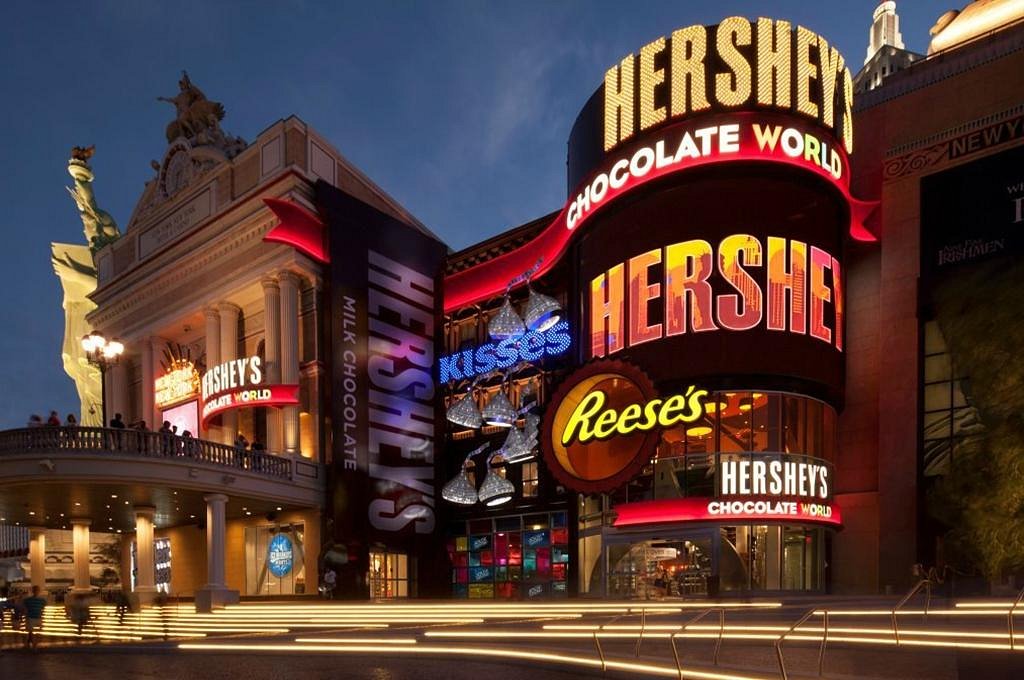
The town of Hershey, Pennsylvania, remains a living testimony to its founder's vision. It is home not only to the chocolate factories but also to major tourist attractions such as Hersheypark (amusement park), Hershey's Chocolate World, the Hershey Gardens and the Hershey Theatre, attracting millions of visitors each year.
In conclusion, The Hershey Company is a business with a rich heritage, built on innovation, quality and a unique philanthropic commitment. While cherishing the traditional chocolate brands that have defined the American taste, Hershey is evolving into a broader snacking player, facing today's challenges of sustainability and market volatility, but still guided by the spirit of its founder.