
History of Cocoa
Historians believe the Olmecs first discovered that the cocoa fruit was edible by watching rats eat it with gluttonous vigour. They soon realised the tree produced a fruit with a thousand…
The Olmecs' Discovery of Cocoa
Historians believe the Olmecs first discovered that the cocoa fruit was edible by watching rats eat it with greedy gusto. They quickly understood that the tree produced a fruit with a thousand flavours and almost as many uses.
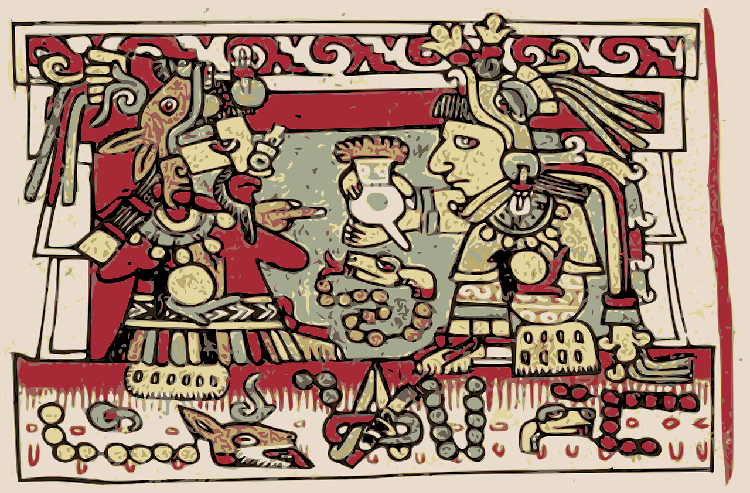
The Olmecs (1500-400 BC) were almost certainly the first humans to consume chocolate, originally as a drink. They ground the cocoa beans, mixed them with water and added spices, chillies and herbs (Coe's theory). They began growing cocoa in equatorial Mexico. Over time, the Maya (600 BC) and the Aztecs (400 AD) also developed effective methods of cocoa cultivation. The cocoa bean was used as a unit of currency and a unit of measure, with 400 beans equal to one Zontli and 8,000 equal to one Xiquipilli. During their wars with the Aztecs and the Maya, the method preferred by the Chimimeken people for collecting taxes in conquered regions was cocoa beans.
For these civilisations, cocoa was a symbol of abundance. It was used in religious rituals dedicated to Quetzalcoatl, the Aztec god responsible for passing the cocoa tree to man, to Ek Chuah, the Maya patron saint of cocoa, and in offerings at the funerals of nobles.
Cocoa production grew as people migrated across Mesoamerica, but drinking it remained a privilege of the upper classes and of soldiers in battle. At that time, the invigorating and fortifying virtues of cocoa were increasingly widely recognised and adopted.

Discovery and Commercialisation of Cocoa (16th Century)
In 1502, Columbus first came across cocoa beans on an indigenous canoe during a stop in Nicaragua, but did not appreciate their incredible potential. The true importance of this "brown gold" was only recognised when Hernando Cortez drank it with the Aztec emperor Montezuma and brought it back to the Spanish court in 1528 with the equipment needed to prepare the drink. Even then, it is unlikely that anyone envisaged its ultimate importance as a world commodity.
After a victorious war against the indigenous tribes and the fall of the Aztec civilisation, Cortez stepped up his cultivation efforts in New Spain, with the aim of developing a lucrative trade with Europe.
The Spanish court quickly fell under the spell of this exotic elixir and adapted it to its taste by adding cane sugar, vanilla, cinnamon and pepper. Initially, Spain reserved cocoa for its exclusive use, carefully protecting its existence from the rest of the world. They kept cocoa so well hidden that when a group of English pirates captured a Spanish galleon, failing to recognise the value of its heavy cargo of beans, they burned them!
In 1585, the first shipment of cocoa beans arrived on the Iberian peninsula from New Spain, launching the cocoa trade and leading to the creation of the first chocolate shops.
The Expansion of Cocoa in Europe (17th-19th Centuries)
In the 17th century, cocoa began to arrive in other European ports, effortlessly conquering the palate of every region. Chocolate drinks were first adopted by the French court following the royal marriage of King Louis XIII to the Spanish princess Anne of Austria in 1615.
In 1650, chocolate drinks first appeared in England, on the occasion of the arrival of tea from China and coffee from the Middle East. For many years it remained a treat reserved for the upper classes. In 1659, the first chocolatier-confectioner opened in Paris. In 1720, Italian chocolatiers received prizes in recognition of the quality of their products. Finally, in 1765, North America discovered the virtues of cocoa.
In this way, chocolate developed in Europe and around the world, and the presentation of chocolate slowly changed. The first chocolate pastille appeared in England in 1674; cocoa powder was originally produced by the Dutch in 1828; the chocolate bar was born in Britain in 1830; and the Swiss entered the chocolate market successfully with milk chocolate in 1830, followed shortly after by chocolate infused with hazelnuts.
Thanks to this long period of culinary innovation and manufacturing, chocolate consumption expanded rapidly and continuously. The pharmacological uses of cocoa and its derivatives were also widely explored, which is hardly surprising given the properties attributed to it by its first consumers (that is, fortifying, restorative, aphrodisiac).

Cocoa in the Industrial Age
The industrial age brought fundamental changes to chocolate and cocoa, affecting everyone from the producer to the final consumer. Spain, the leading chocolate exporter, opened the first chocolate factory in 1780 in Barcelona, followed shortly by Germany and Switzerland in the inexorable and relentless march towards the full industrialisation of cocoa.
The origins of cocoa also gradually changed. Europeans began colonising Africa more and more and they brought the cocoa tree with them. Cocoa was successfully planted in São Tomé and Príncipe and then spread in the form of plantations across the whole African continent. The industrial era led to the slow decline of production in South America, despite its expansion of the original production areas as far as the Amazon river and the birth of a new cocoa empire on African soil. Indeed, since the start of the 20th century, Africa has taken the lead and become the biggest cocoa producer.
Industrialisation had a marked democratising effect on chocolate, transforming it from a rare delicacy reserved for royal families into a treat widely available and easily affordable for the masses. Unsurprisingly, a plethora of new chocolate products began to appear as its popularity grew, including chocolate with dried fruit and nuts, liqueurs, fondants, pralines, filled chocolates, powders, spreads, icings, pastes, hard candies, soft drinks and many others. Handmade or as fast food, it is now part of the world's vocabulary and diet. Many improvements have been made since its ancient origin as a drink. Anthelme Brillat-Savarin poetically summed up our universal love affair with chocolate: "What is health? It is chocolate!"