The History of Cocoa in Côte d'Ivoire: An In-Depth Study of Historical, Economic and Socio-Environmental Dynamics
The cocoa sector in Côte d'Ivoire is much more than a mere component of its economy; it is its "lifeblood", deeply rooted in the daily lives of farmers, industrialists, politicians and service providers…

Introduction
The cocoa sector in Côte d'Ivoire is much more than a mere component of its economy; it is its "lifeblood", deeply rooted in the daily life of farmers, manufacturers, politicians and service providers for more than a century. Its reach goes beyond the simple production of raw materials, forming a crucial element of the national fabric. Economically, cocoa accounts for a substantial 10% of the country's GDP and remains the main export product, forming the cornerstone of the national economy since Côte d'Ivoire's independence in 1960. The country maintains its position as the world's leading cocoa producer, contributing 40% of world production, with projections indicating that this share could reach 45% in 2024. In 2015, Côte d'Ivoire produced about 1.7 million tonnes, or 35% of world production.
The sector supports the livelihoods of an immense part of the population, with more than 6 million people — more than a third of Ivorians — depending on cocoa. This dependence rests mainly on small-scale farming, with about 1 million producers growing cocoa on plots averaging 3 hectares. Despite this pervasive economic importance, cocoa's direct contribution to GDP has shown a gradual decline since 1991. Nevertheless, its indirect economic channels and its influence on fiscal policy remain of paramount importance. The economy's heavy dependence on this monoculture makes it extremely vulnerable to erratic price swings on international markets, a vulnerability that has shaped its historical trajectory.
It is observed that, although cocoa is consistently described as the "lifeblood" and main economic driver of the country, the data reveal a complex situation. Its direct contribution to GDP has fallen since 1991, and the economy remains very sensitive to price volatility. This suggests that, despite its fundamental role, Côte d'Ivoire has struggled to turn its cocoa dominance into stable, diversified economic growth. This situation creates a structural fragility in which the very source of prosperity also acts as a significant risk factor. The vast quantity of raw material exported does not always translate into proportionate value capture or broader economic diversification. This reality highlights a fundamental problem: excessive dependence on a single, volatile commodity which, while generating substantial export revenue, has not fostered a resilient, diversified economy. The "lifeblood" metaphor, though powerful, also implies a singular dependence that can prove dangerous if the source is unstable or if the value is not effectively retained in the country.
This report aims to offer an in-depth historical analysis of cocoa growing in Côte d'Ivoire. It will meticulously trace the origins of the crop, its development under the distinct policies of colonial rule, and its evolution through various post-independence government strategies. The study will explore the deep, multifaceted economic, social and environmental impacts that cocoa has had on the nation. It will also examine the complex interplay of policies, the diversity of players in the value chain, and the broader global-market dynamics that have continually shaped the Ivorian cocoa sector. Finally, the report will conclude with an examination of the contemporary challenges facing the industry and the ongoing sustainability initiatives designed to foster a more resilient and fairer future.
I. The Origins and Introduction of Cocoa in Côte d'Ivoire (Late 19th - Early 20th Century)
A. Context of French Colonisation and Early Initiatives
The genesis of cocoa production in Côte d'Ivoire is intrinsically linked to the French colonial enterprise of the late 1800s. After establishing a protectorate in 1843 and formally consolidating it as a French colony in 1893, the colonial administration undertook a systematic exploitation of the region's natural resources, including timber, rubber and palm oil. The introduction of cocoa is attributed to the French agronomist Louis Tautain, who in 1895 brought cocoa seeds from the island of Fernando Po (today Bioko, Equatorial Guinea). Tautain set up an experimental plantation near Grand-Bassam, on the coast, where he perfected cultivation methods and later distributed seeds to local farmers.
At the same time, other sources stress the central role of Arthur Verdier, another French pioneer, who played a crucial part in the agricultural development of the Assinie region, the country's first French colonial trading post, as early as the 1870s. Under his impetus, cocoa growing is said to have begun in 1881, alongside the first coffee plantations. These accounts suggest either multiple, perhaps uncoordinated, early introduction efforts or a more complex, multifaceted process of initial dissemination. It is important to note that the large-scale spread of cocoa in Côte d'Ivoire came some 15 to 20 years after its first commercial cultivation in neighbouring Gold Coast (Ghana), indicating a relatively later start for the Ivorian sector.
B. Favourable Climatic and Geographic Conditions
Côte d'Ivoire's tropical climate proved exceptionally suited to cocoa growing. Characterised by distinct wet and dry seasons, the period from April to October brings abundant rainfall, generally between 1,500 and 2,000 mm a year, which is essential for the development of the cocoa plant. The cacao tree (Theobroma cacao), which naturally thrives within 10° of the equator – a zone that fully encompasses Côte d'Ivoire – finds its optimal environment in the country's conditions. Beyond climate, the Ivorian forest zone offered fertile soils, rich in coarse particles and essential nutrients, with sufficient depth (at least 1.5 m) to support robust root systems and ensure adequate drainage. These natural assets were essential catalysts for the rapid expansion of cocoa.
C. Adaptation and Initial Adoption by Local Populations
Despite the favourable natural conditions and the initial colonial efforts, early cocoa growing met significant obstacles. These included challenges in adapting the crop to specific local conditions, soil suitability and pest management. Crucially, there was notable scepticism and resistance among local farmers, who were initially wary of this unfamiliar plant.
However, this initial reluctance gradually gave way to widespread adoption. Local populations were increasingly motivated by cocoa's evident economic benefits, recognising it as a profitable alternative to traditional food crops. The appeal of a cash economy, the need to pay colonial taxes and the desire to acquire manufactured goods acted as powerful incentives for indigenous communities to gradually take up cocoa growing. This change marked a fundamental transformation of local farming practices, moving towards cash-crop production.
It is worth stressing that, although the French colonial powers introduced cocoa mainly for resource extraction and imperial economic benefit, its widespread and successful adoption by local Ivorian farmers was not a simple passive imposition. On the contrary, it was considerably motivated by the local people's own economic rationality: the pursuit of cash income, the means to pay colonial taxes and the desire to acquire manufactured goods. This dynamic is more complex than a simple colonial command, because it highlights the agency of local communities in taking up a new crop based on perceived advantages within the changing colonial economic framework. This active decision by farmers, driven by economic incentives, was essential to cocoa's spread and long-term success, making it more than a mere colonial imposition.
The early shift from growing traditional food crops for subsistence or local use to prioritising cash crops like cocoa for monetary gain, although economically rational in the immediate colonial context, inadvertently laid the foundations for Côte d'Ivoire's economic vulnerability. This early specialisation created a dependence on monoculture that would later expose the nation to severe price volatility on world markets and contribute significantly to long-term environmental degradation (deforestation) as the industry grew. The very strategy that brought initial prosperity also built in the risks of future crises, establishing a long-term causal link between early farming choices and later national challenges.
II. The Colonial Era and the Expansion of Cocoa Growing (Early 20th Century - 1960)
A. French Colonial Policies and Their Impact on Production
French colonial policy in Côte d'Ivoire stood out for being "more interventionist and restrictive" than British approaches in neighbouring colonies such as Ghana and Nigeria. This interventionism showed itself in various ways, notably through the initial growing of cocoa on Ivorian territory by forced labourers on plantations. This exploitative labour system persisted, with similar cases of slavery and forced labour reported on Côte d'Ivoire's plantations up to the Second World War. However, a significant reform came in 1946 with the abolition of most forced labour laws.
The colonial administration actively promoted cocoa production through strategic infrastructure development. This included building and improving the road network and extending the Abidjan-Niger railway. This transport infrastructure was crucial for opening up previously inaccessible interior production areas and enabling the efficient movement of cocoa beans to the port of Abidjan, which quickly became an essential hub for the cocoa trade. The Ivorian cocoa economy grew rapidly in the 1920s, a period partly boosted by the depreciation of the French franc. This currency devaluation effectively raised local cocoa prices, offering a strong economic incentive that motivated and further extended cocoa growing among farmers. After the First World War, French policy showed some hesitation between supporting European plantations and encouraging African farmers. This led to the proliferation of countless small farms, a feature that would define the Ivorian cocoa landscape.
French colonial policy in Côte d'Ivoire, characterised by its "interventionist and restrictive" nature and its initial reliance on forced labour, paradoxically laid crucial foundations for the future dominance of the cocoa sector. By developing essential infrastructure such as roads and railways and creating economic incentives such as the franc's depreciation, the colonial administration, despite its exploitative methods, established the physical and economic pathways that enabled cocoa's massive expansion and global leadership. This created a complex legacy in which exploitation coexisted with the building of a powerful economic engine.
B. Labour and Migration Dynamics (Including Forced Labour)
As mentioned, cocoa was initially grown using forced labourers on plantations. Reports indicate that various forms of illegal labour, including child labour and slavery, were widespread in West African cocoa production from the late 19th century until the 1950s, and Côte d'Ivoire was no exception. The expansion of cocoa growing, particularly in the southern forests, required a substantial workforce, largely supplied by migrant workers. The colonial state actively encouraged this migration, directing workers to the western forest areas from the central and northern regions of Côte d'Ivoire, as well as from across its borders. This created a distinctive "frontier" dynamic, in which agricultural expansion was intrinsically tied to labour mobility.
The abolition of forced labour in 1946, combined with the promise of better living conditions and pay in Côte d'Ivoire than in neighbouring countries, triggered a new boom in cocoa production in the 1950s by attracting more immigrants. This migration trend continued after independence, with the Ivorian government's promise that "the land belongs to those who make it bear fruit" drawing more immigrants to the cocoa and coffee economy.
C. Production Growth and the Emergence of "Pioneer Fronts"
The combination of colonial policies, a favourable climate and labour dynamics led to significant growth. As early as 1911, Côte d'Ivoire had already become the world's fourth-largest cocoa producer, overtaking Brazil and Nigeria a decade later to rank second behind Ghana in 1939. The rapid growth seen in the 1920s, fuelled by the franc's depreciation, and the continued subsequent expansion into new agricultural frontiers propelled rapid development of the sector.
A defining feature of the rise of cocoa in Côte d'Ivoire was the pronounced nature of its expansion through "pioneer fronts", far more marked than in Ghana or Nigeria. This phenomenon was particularly intense from the 1950s to the 1980s, as a cocoa pioneer front swept with remarkable speed and intensity from the centre of the country to its south-western forest zone. This aggressive "rush to the west" was of exceptional scale, allowing Côte d'Ivoire not only to overtake its West African neighbours but eventually to become the world's largest cocoa supplier, accounting for about a third of world production.
The systematic reliance on migrant labour, begun in the colonial period to fuel the expansion of the "pioneer fronts" and intensified after independence with policies like "the land belongs to those who make it bear fruit", was an essential factor in Côte d'Ivoire's rapid rise to become the world cocoa leader. However, this mass migration, though economically vital, simultaneously laid the foundations for significant future socio-political challenges, in particular the inter-ethnic and political tensions arising from land scarcity. This demonstrates a deep, long-term causal link between labour policy, agricultural expansion and the emergence of social instability.
III. The Post-Independence Golden Age and the "Ivorian Miracle" (1960s - 1980s)
A. The Role of Félix Houphouët-Boigny and Supportive Policies
Côte d'Ivoire's independence in 1960 marked a significant turning point, giving new impetus to its local cocoa industry. Under President Félix Houphouët-Boigny, who governed from 1960 to 1993, agriculture — particularly coffee and cocoa — was strategically positioned as the main engine of national economic development. This period became famous as the "Ivorian miracle".
Houphouët-Boigny, himself descended from a tribe of cocoa growers and a wealthy farmer, skilfully used his political power and education to champion the advancement of the cocoa sector. His early efforts included founding the African Agricultural Union (SAA), specifically designed to represent the interests of indigenous farmers against those of French citizens. His policies throughout the 1960s and 1970s proved very effective in boosting cocoa growing. These measures included direct subsidies to farmers, the provision of extension services and, above all, higher prices paid to producers. His political ties in France also facilitated international partnerships with global chocolate companies and organisations.
A central pillar of this post-independence strategy was the creation of the "Caisse de Stabilisation des Prix des Produits Agricoles (Caistab)" in 1955, which took on central importance from 1964. The Caistab's mandate was to guarantee stable purchase prices to producers and manage export marketing, thereby providing a vital sense of security and greatly stimulating the massive expansion of plantations.
B. Production Boom and Consolidation of Global Position
The post-war period saw significant labour improvements and the abolition of most forced labour laws in 1946. These reforms, combined with increased immigration attracted by better living conditions and wages than in neighbouring countries, triggered a new boom in cocoa production in the 1950s. This momentum continued after independence, with the 1970s consolidating Côte d'Ivoire's position as the undisputed world leader in cocoa production. Volumes rose dramatically, quickly passing the symbolic threshold of one million tonnes a year. In 1978, Côte d'Ivoire officially overtook Ghana to become the world's largest producer of cocoa beans. This unprecedented increase in production was largely achieved through the continued expansion of cultivated areas, often into new forest frontiers.
C. Major Economic Contribution (GDP, Export Revenue)
During the 1960s and 1970s, Côte d'Ivoire became a formidable "economic powerhouse" in West Africa, mainly thanks to its robust coffee and cocoa production. The country's GDP per capita grew remarkably, rising by nearly 82% in the 1960s and peaking at an average growth rate of 360% in the 1970s. Cocoa's economic footprint was immense: it accounted for 40% of national export earnings and contributed 20% of GDP. In 2015, cocoa-related revenue alone accounted for more than 15% of the country's GDP, with cocoa exports generating about 50% of its total export earnings. Note the slight variations in the percentages of GDP contribution between sources, probably due to different reporting years or methodologies (for example 20% in one source versus 15% in another for 2015).
The commodity boom of the mid-1970s, during which cocoa prices reached unprecedented highs, flooded the country with foreign currency. This influx of capital financed major infrastructure projects across the country, symbolising the tangible success of the "Ivorian miracle". The Caistab, the state stabilisation fund, built up considerable surpluses during this period, reinforcing its role as a powerful instrument of state economic policy and a mechanism for partial redistribution of cocoa wealth.
The "Ivorian miracle", while ushering in a period of unprecedented economic growth and global cocoa leadership, was largely built on an extensive, state-managed model of agricultural expansion (Caistab, subsidies, encouraged migration). This approach, though effective for production volume, simultaneously fostered an unsustainable dependence on extensive cultivation, causing massive deforestation and deepening the country's dependence on monoculture. It laid the groundwork for the serious economic and environmental crises that would emerge in the 1980s, revealing that the seeds of future fragility were sown during this period of apparent success.
The Stabilisation Fund (Caistab) played a central role in the "golden age" by guaranteeing purchase prices and managing export marketing, thus providing crucial security and stimulating production. Its accumulation of considerable surpluses also consolidated its position as a powerful instrument of state economic policy. However, this centralised control, though beneficial during a period of growth, created a system highly vulnerable to external price shocks. When world cocoa prices inevitably collapsed in the 1980s, the Caistab's inability to maintain producer prices without crippling public finances highlighted the risks inherent in such a centralised, state-dependent model, ultimately contributing to the sector's crisis and the drastic fall in farmers' incomes.
To put these dynamics in context, the table below presents a timeline of key events and the evolution of production.
Table 1: Timeline of Cocoa Production in Côte d'Ivoire and Key Events
| Year/Period | Production Volume/Market Share | Key Event/Policy |
| 1881 | First crops | Introduction of cocoa by Arthur Verdier |
| 1895 | First plantations | Introduction of cocoa by Louis Tautain from Fernando Po |
| 1911 | 4th-largest producer in the world | Côte d'Ivoire becomes the world's 4th-largest producer |
| 1912 | 20,954 kg harvested | Start of the rise in production |
| 1918 (end of WWI) | 420 tonnes | Modest but promising rise in production |
| 1920s | Rapid growth | Depreciation of the franc stimulates cultivation |
| 1939 | 2nd-largest producer in the world | Overtakes Brazil and Nigeria, 2nd behind Ghana |
| 1946 | Production boom | Abolition of forced labour, influx of immigrants |
| 1955 | Creation of the Caistab | Founded to stabilise prices and manage the market |
| 1960 | Independence | Cocoa becomes the cornerstone of the economy |
| 1960s-1970s | "Ivorian Miracle" | Houphouët-Boigny's policies, subsidies, extension services, high prices |
| 1970s | Exceeds 1 million tonnes/year | Consolidation of world-leader position |
| 1978 | World's #1 producer | Overtakes Ghana as largest cocoa bean producer |
| 1980s | Economic crisis | Collapse of world prices, Caistab deficits |
| 1991 | Decline in direct GDP contribution | Cocoa's direct share of GDP falls |
| 2015 | 1.7 million tonnes (35% of world) | High production, but persistent vulnerability |
| 2021 | 2.25 million tonnes | Production continues to be high |
| 2024 | 45% of world production | Projected world market share |
IV. Contemporary Crises and Challenges (1980s - Present)
A. World Price Volatility and Economic Crises
The "Ivorian miracle" faced a serious economic crisis in the 1980s, marked by a significant contraction of GDP, which fell by about 28%. The downturn was mainly triggered by the collapse of world cocoa prices, a phenomenon partly worsened by global overproduction (to which Côte d'Ivoire had contributed considerably) and the eventual dissolution of the international cocoa agreements meant to regulate prices.
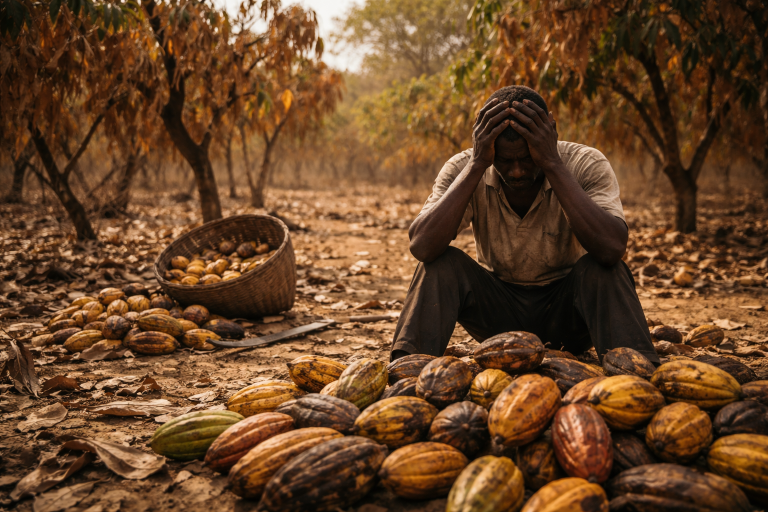
The drastic price fall put severe strain on the Stabilisation Fund (Caistab), which, once a source of surpluses, now faced chronic deficits. It became unable to support producer prices without further worsening public finances. The heavily indebted Ivorian state was forced to seek help from the Bretton Woods institutions (IMF and World Bank), which advocated drastic structural reforms, including liberalising the cocoa sector and challenging the Caistab's monopoly. The direct consequence for farmers was devastating: cocoa producers became highly vulnerable to price shocks and production risks, which prevented them from reaching a decent standard of living. Hundreds of thousands of Ivorian planters experienced a drastic and prolonged fall in income, leading to a significant deterioration in their living conditions and widespread disenchantment.
B. Environmental Impacts: Deforestation and Soil Degradation
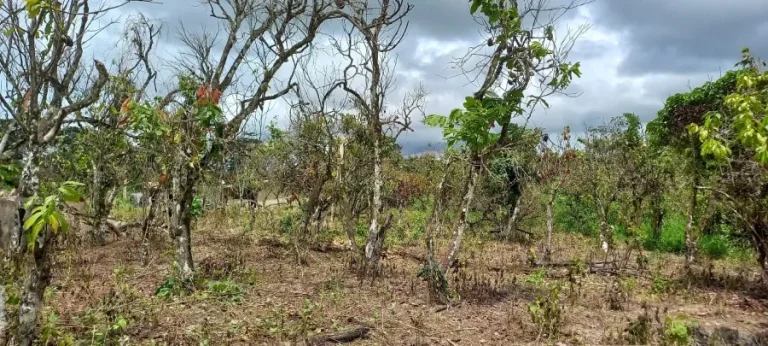
The expansion of cocoa growing has been identified as the main driver of deforestation in Côte d'Ivoire. A substantial portion of cocoa is grown illegally in protected forest reserves and national parks, causing dramatic and often irreversible forest destruction. The historical expansion of the "pioneer fronts" involved extensive clearing of forest land and the felling of primary forest. A key factor perpetuating this cycle is the declining productivity of older plantations because of soil nutrient depletion and increasing pest and disease pressure. After 20 to 30 years, farmers often find it simpler and more economically viable to clear new forest areas than to invest in costly replanting and soil improvement on existing land.
The environmental cost has been severe: in the decade before 2004, Côte d'Ivoire experienced an alarming annual deforestation rate of 7.6% of its closed-forest area, halving its forest cover in ten years. This led to deep ecological imbalances, showing up as prolonged dry seasons, markedly reduced rainfall and extreme temperatures. In response to these challenges, agroforestry is increasingly advocated as a sustainable solution. The practice aims to combine cocoa production with forest restoration, improve soil fertility and diversify farmers' incomes, thus offering a route to more environmentally friendly cultivation.
C. Social Issues: Producer Poverty, Child Labour and Forced Labour
Despite Côte d'Ivoire's global leadership in cocoa production, the economic benefits are distributed disproportionately. Farmers receive a tiny share, earning less than 6% of the chocolate industry's total revenue. Daily incomes of cocoa producers in Côte d'Ivoire hover around US$0.78, leading to widespread poverty: a significant proportion of households (30 to 58%) earn a gross income below the World Bank's extreme poverty line, and the great majority (73 to 90%) fall short of a living income.
Child labour remains endemic in the industry, with about 1.56 million children engaged in child labour on cocoa plantations in Côte d'Ivoire and Ghana. In addition, forced labour, often described as "modern slavery", poses a serious risk in the sector. Children involved in cocoa production often endure arduous conditions, working long hours, using dangerous tools like machetes and chainsaws, and facing physical abuse if their work is judged too slow or if they try to escape. Traffickers frequently exploit vulnerable children and their families with false promises of lucrative job opportunities in Côte d'Ivoire.
The persistence of these labour abuses is worsened by deep-seated problems such as persistent poverty, inadequate access to education, growing world demand for cocoa and the intensification of farming practices. Existing child labour laws often do not apply to family farms, creating a legal loophole that perpetuates the problem. Gender disparity is also a significant social challenge: women do about 70% of the work on cocoa plantations but receive only about 20% of the income, and only 25% of landowners are women.
The low productivity of cocoa plantations, which directly results in persistently low incomes for farmers, creates a vicious circle that simultaneously encourages more deforestation and perpetuates the use of child labour and forced labour. These problems are not isolated but deeply linked symptoms of a structurally vulnerable and inequitable global cocoa value chain, in which intense economic pressure on the most fragile producers translates directly into serious environmental degradation and widespread human-rights violations. Poverty drives unsustainable practices and labour abuses, which in turn undermine productivity and long-term sustainability, perpetuating poverty.
Côte d'Ivoire's historical and continued dependence on cocoa, while placing it in a position of global leadership, has paradoxically made it a striking example of the "resource curse" phenomenon. The inherent boom-and-bust cycles of commodity markets, combined with the state's heavy reliance on cocoa revenue, have led to significant underinvestment in other economic sectors, hindering real economic diversification. This over-specialisation has not only created economic instability but also worsened pre-existing social and political tensions, notably those linked to land and migration. It shows how a single dominant commodity can be the source of both periods of prosperity and deep, multifaceted national crises.
The table below provides key statistics on these social and environmental challenges.
Table 2: Social and Environmental Challenges in the Cocoa Sector (Key Statistics)
| Challenge Area | Statistic/Period |
| Annual deforestation rate | ~7.6% (decade before 2004) |
| Children in child labour | ~1.56 million (Côte d'Ivoire and Ghana) |
| Children in forced labour | ~0.17% (in Côte d'Ivoire) |
| Adults in forced labour | ~0.42% (in Côte d'Ivoire, 2013-2017) |
| Households below the extreme poverty line | 30-58% of cocoa-farming households |
| Households without a living income | 73-90% of cocoa-farming households |
| Women's share of income | 20% (for 70% of the work) |
V. Côte d'Ivoire in the World Cocoa Market: Current Trends and Sustainable Initiatives
A. Evolution of Market Share and International Competition
Côte d'Ivoire has consistently maintained its position as the world's leading cocoa producer since 1978, currently holding about 40% of world production. This dominance is expected to rise further, reaching 45% in 2024. West Africa collectively accounts for two-thirds of the world cocoa harvest, with Ghana the world's second-largest producer.
Beyond Africa, Indonesia has become a significant competitor, going from an almost non-existent national cocoa industry in the 1970s to one of the largest producers on the market by the early 2000s. Recent trends point to volatility in world supply. World cocoa production is expected to fall by 13.1% in the 2023/24 season, leading to the largest world deficit in more than 60 years, estimated at -494,000 metric tonnes (MT). However, a world cocoa surplus of 142,000 MT is forecast for 2024/25, marking the first surplus in four years.
B. Local Processing and Value Addition Efforts
A major challenge for Côte d'Ivoire is its limited value capture in the global cocoa supply chain. Nearly half of the country's cocoa beans are exported raw, resulting in a significant loss of potential value added. Currently, Côte d'Ivoire retains only 13% of the total value added in the cocoa chain. To address this, the Ivorian government has set itself an ambitious goal: to process 100% of the country's cocoa production locally by 2030, a strategy that includes planning the creation of three new industrial processing units.
The rationale for increased local processing is manifold: it can help reduce cocoa price volatility by allowing better management of semi-finished product stocks, and it can considerably strengthen the country's bargaining power with the main global players in the cocoa industry by adding value to its exports. However, the road to achieving this goal is strewn with obstacles, including securing adequate financing, acquiring more efficient processing equipment, expanding production capacity, and even developing a stronger national chocolate-consumption culture in Côte d'Ivoire itself.
Côte d'Ivoire's ambitious goal of processing 100% of its cocoa locally by 2030 represents a crucial strategic shift, from mere raw-material exporter to capturing significantly more value inside the country. However, the challenges identified – lack of financing, the need for efficient equipment and even the absence of a strong national chocolate-consumption culture – suggest that achieving this industrial transformation requires not only investment but also a fundamental rethink of global value chains and consumer markets. It is a long-term economic-transformation challenge which, if successfully met, could provide a more stable base from which to tackle the social and environmental problems afflicting the raw cocoa sector.
C. Sustainability Policies and Programmes (Agroforestry, Living Income, Fighting Abuses)
Agroforestry: This practice is increasingly recommended as a holistic solution for producing cocoa sustainably, simultaneously restoring forest cover, improving soil fertility and diversifying farmers' incomes. Many agribusinesses have already launched agroforestry pilot projects, committing to deforestation-free production targets by 2020. A major obstacle, however, remains the significant financing farmers need during the initial transition period, because local banks are often reluctant to lend.
Living Income (Living Income Differential – LID): In a concerted effort to fight farmer poverty, Côte d'Ivoire and Ghana jointly introduced a premium of US$400 per tonne on the export price for the 2020/21 season, known as the Living Income Differential. Despite this initiative, reports indicate that the chocolate multinationals have often circumvented payment of this premium by making indirect purchases or diversifying their cocoa sources.
Fighting Child Labour and Forced Labour: International organisations such as the Child Labor Cocoa Coordinating Group (CLCCG) and the International Cocoa Initiative (ICI) are actively engaged in preventing and fighting child labour and forced labour in the cocoa sector. These efforts involve innovative public-private partnerships with governments and industry stakeholders. Nevertheless, despite these significant efforts, results on the ground remain limited, with millions of children still affected by exploitative labour practices.
Traceability: Implementing robust traceability systems is seen as crucial to giving consumers a credible guarantee of responsible cocoa production, linking ethical sourcing directly to market demand.
Land Tenure Security: The lack of land tenure security for farmers is identified as an indirect but significant driver of deforestation, as it discourages long-term investment in sustainable farming practices and encourages short-term exploitation of new land. Resolving this insecurity is a prerequisite for implementing effective sustainable-development initiatives.
Although many national and international initiatives (for example agroforestry, the Living Income Differential, child-labour programmes) are in place to foster sustainable and fair cocoa production, their effectiveness on the ground is severely limited by persistent structural problems. These include multinationals' strategies to avoid premiums, farmers' entrenched poverty, significant financing gaps for sustainable transitions, and inadequate enforcement of labour laws. This highlights a critical mismatch between well-intentioned policy goals and the complex, often resistant realities of market forces and systemic vulnerabilities. Sustainability mechanisms exist, but the underlying power dynamics and economic realities (for example market pressure for low prices, corporate profit motives, farmer poverty) actively undermine their success.
Conclusion
The history of cocoa in Côte d'Ivoire is a captivating story of extraordinary growth and profound transformation. It began with its introduction under French colonial rule, characterised by exploitative labour practices, but at the same time saw the setting up of basic infrastructure and the emergence of local economic incentives. The post-independence era, particularly under Félix Houphouët-Boigny, marked an "Ivorian miracle", propelling the nation to its present status as the world's largest cocoa producer through state-led expansion and mass migration.
However, this remarkable success came at significant and lasting costs. The country's deep economic vulnerability to volatile world cocoa prices, extensive and relentless deforestation caused by agricultural expansion, and persistent human-rights problems, including widespread child labour and forced labour, along with pervasive farmer poverty, are direct consequences of this development model. The "Ivorian miracle", while achieving unprecedented production volumes, was fundamentally built on an unsustainable model, revealing an essential lesson: an economy based on a single commodity, even when globally dominant, can lead to structural imbalances, serious social inequalities and long-term environmental degradation.
Outlook and Recommendations for a Sustainable Sector
To ensure a more resilient and fairer future for the Ivorian cocoa sector, several strategic priorities are essential:
- Economic diversification: To mitigate the risks inherent in monoculture and price volatility, Côte d'Ivoire must strategically reduce its excessive dependence on cocoa by actively fostering the development and growth of other agricultural and industrial sectors. This will create more resilient livelihoods and a more stable national economy.
- Sustainable intensification and agroforestry: A fundamental shift towards sustainable farming practices, particularly agroforestry, is imperative. This means promoting and funding methods that increase yields on existing land, thereby reducing the pressure for further deforestation and improving ecological resilience. It is crucial to remove the persistent obstacles farmers face in accessing adequate finance, technical knowledge and quality inputs.
- Improving producers' incomes: Effective mechanisms, such as the Living Income Differential, must be rigorously implemented and enforced to ensure that fair, stable prices actually reach farmers. Tackling the underlying structural factors that increase farmers' vulnerability to price shocks and market power imbalances is paramount to lifting them out of poverty.
- Fighting child labour and forced labour: A multidimensional approach is needed to eradicate child labour and forced labour. This includes strengthening legal frameworks and their enforcement, along with targeted socio-economic programmes that tackle the root causes of these abuses, such as poverty, lack of access to education and inadequate social safety nets. Fostering direct, transparent engagement between international industry players and local farmer cooperatives is also vital.
- Land tenure security: Implementing clear, fair and secure land policies is an essential prerequisite for sustainable development. Such policies will encourage farmers to make long-term investments in their land, adopt sustainable farming practices and reduce the destructive pressure to clear new forest.
- Local processing: Strategic, sustained investment in cocoa-processing infrastructure and capacity building at national level is essential for Côte d'Ivoire to capture a greater share of the global value chain. This will not only create much-needed jobs but also diversify the economy's sources of income. Overcoming existing obstacles linked to financing, technology transfer and market access for processed products is essential.
- Stronger governance: Improving transparency, accountability and good governance in the cocoa sector's regulatory bodies, such as the Coffee-Cocoa Council, is crucial. This will ensure fair distribution of wealth, effective oversight of sustainability initiatives and the long-term health and resilience of the entire cocoa value chain.
Table 3: Key Economic Indicators of the Cocoa Sector in Côte d'Ivoire
| Economic Indicator | Period/Year | Value |
| Contribution to GDP | 1960s | ~4% (manufacturing) |
| 2015 | >15% (cocoa-related revenue) | |
| Current | 20% | |
| Export Revenue | 1950s | 3% |
| 2015 | ~50% | |
| Current | 40% of national export revenue | |
| Farmers' Daily Income | Current | ~$0.78/day |
| Current | ~568 CFA francs/day (below the poverty line) | |
| Global Market Share | 2015 | 35% |
| Current | 40% | |
| 2024 (proj.) | 45% | |
| Local Value Capture | Current | 13% of total value added |