The History of the Old Cocoa Loop in Côte d'Ivoire
The former Cocoa Loop comprised the three current departments of east-central Côte d'Ivoire: Dimbokro, Daoukro and Bongouanou.
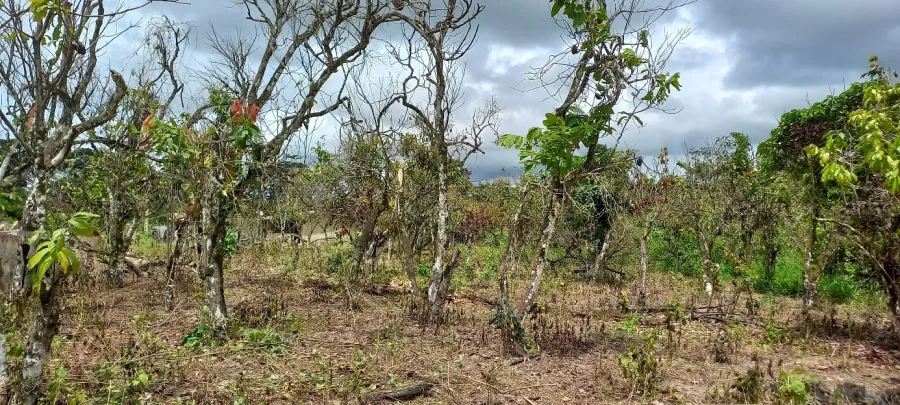
The old Cocoa Loop (Boucle du Cacao) covered the three present-day departments of east-central Côte d'Ivoire: Dimbokro, Daoukro and Bongouanou.
Once a prosperous region and a major hub of rural immigration, this area has seen a reversal of fortune, becoming an important centre of emigration.
History
Introduced in the early 20th century in the forest regions of Côte d'Ivoire, coffee and cocoa growing boomed as never before after the 1950s. The growing importance of these crops in the former Dimbokro district earned the region the nickname of the Cocoa Loop. As the main source of wealth, the plantation economy was a great success among local populations, making this region the country's largest production zone.
In terms of area, the region held between 22 and 28% of the total cocoa-planted area in Côte d'Ivoire from 1950 to 1968. From 1969 to 1972, that share fell to under 22%, but the region kept its first rank. For coffee, the Cocoa Loop also ranked first in terms of area from 1950 to 1952 and from 1955 to 1977, with a share fluctuating between 12 and 22% of the total area cultivated.
In terms of production, the Cocoa Loop led all regions, holding more than 28% of cocoa production until 1968. For coffee production, until 1969, the region still held first place with a share of between 21 and 24%.
Labour and Immigration
The development of the forest plantation economy required the input of foreign labour, which fostered its expansion. This labour, once reserved for European owners, was forbidden to African planters by a 1941 decree. European settlers used this labour through "forced labour". Coming mainly from the colony of Upper Volta, this labour once headed en masse to the cocoa plantations of the British colony of the Gold Coast (now Ghana).
Decline and Consequences
The decline of the plantation economy is inherent in the internal logic of the farming system adopted by the peasants. The main characteristics of this system can be summarised as follows:
- Weak means of production and heavy use of labour: Most of the means of production are limited to the machete, the axe and the daba (hoe), rudimentary tools that make human energy the main element of the production process. The use of chemical inputs is, with rare exceptions, absent from peasants' daily practice.
- Heavy consumption of forest: Peasant farming is based on shifting cultivation. Each year, a new plot is cleared either for food crops or to expand the planting of perennial crops.
- Low productivity: Despite the use of often numerous labourers, coffee and cocoa yields are low; they are generally below 400 kg/ha, whereas regular maintenance work could more than double them. In their activities, peasants seem to choose to produce at lower cost without necessarily aiming for maximum profitability. Indeed, the cheapest factor of production (land) is exploited to the full at the expense of production tools and inputs.
Access to land in the Cocoa Loop follows customary rules that give every native a right of use over the village land, with no payment and no possibility of selling the land. In the logical continuation of these customary rules, land was once a collective heritage of villagers, and individual ownership did not exist. The introduction of coffee and cocoa, perennial crops, helped establish and consolidate individual ownership. The race for the forest it generated allowed not only an increase in cultivated area, but above all a waste of the forest. Indeed, all the vast plantations created in the heat of the race for the forest could not be properly maintained. Two main reasons explain this: the rudimentary nature of the production tools and the relative scarcity of labour, as well as the low use of chemical inputs, which leads to low yields. As a result, to increase their incomes, peasants resort to expanding the area cultivated by opening new plots each year.