The Cocoa Tree
Cocoa (Theobroma cacao), also called the cacao tree, is an evergreen tropical tree (mallow family) grown for its edible seeds, whose scientific name means "food of the gods" in Greek. Native to…
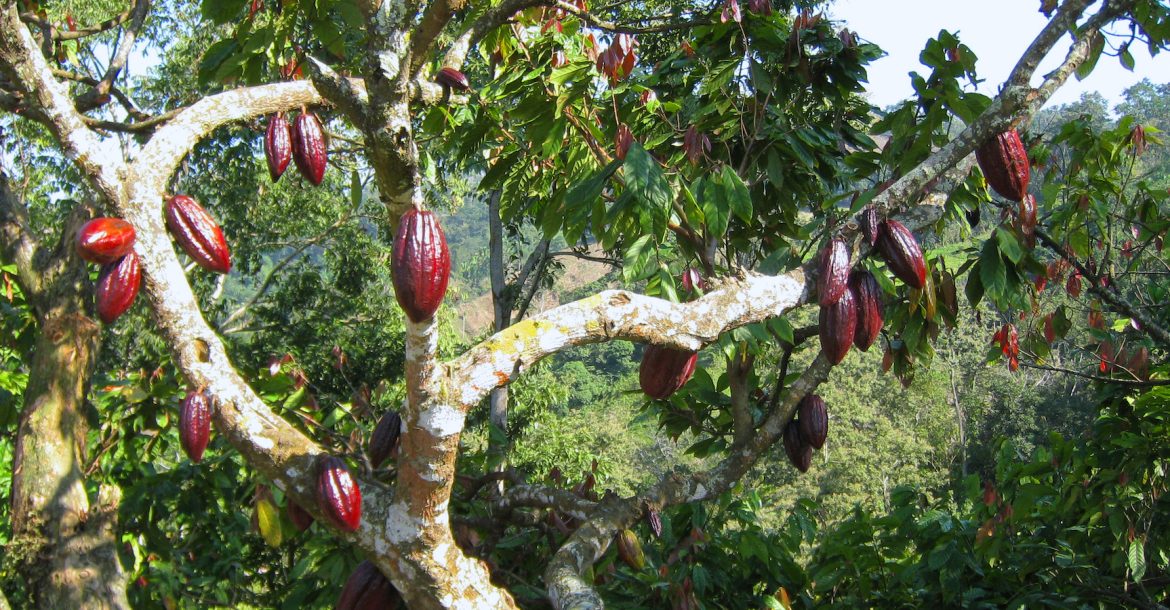
The cacao tree (Theobroma cacao), also called the cocoa tree, is a tropical evergreen tree (family Malvaceae) grown for its edible seeds, whose scientific name means "food of the gods" in Greek. Native to the lowland tropical forests of the Amazon and Orinoco river basins, cocoa is grown commercially in the New World tropics, as well as in West Africa and tropical Asia. Its seeds, called cocoa beans, are processed into cocoa powder, cocoa butter and chocolate. This article deals with the cultivation of the cocoa plant. For more information on cocoa processing and the history of its use, see the article on cocoa.

Natural History
Cocoa grows in the forest understorey at a height of 6 to 12 metres (20 to 40 feet), generally staying at the lower end of this range. Its oblong leathery leaves are up to 30 cm (12 inches) long. They are periodically shed and replaced by new leaves that are bright red when young. Its flowers are foul-smelling or odourless; they may be present at any time but appear in abundance twice a year. These flowers grow in clusters directly from the trunk and limbs and are about 1 cm (0.4 inch) high and wide. They may be white, pink, yellow or bright red, depending on the variety, and are pollinated by tiny flies called midges in many regions.
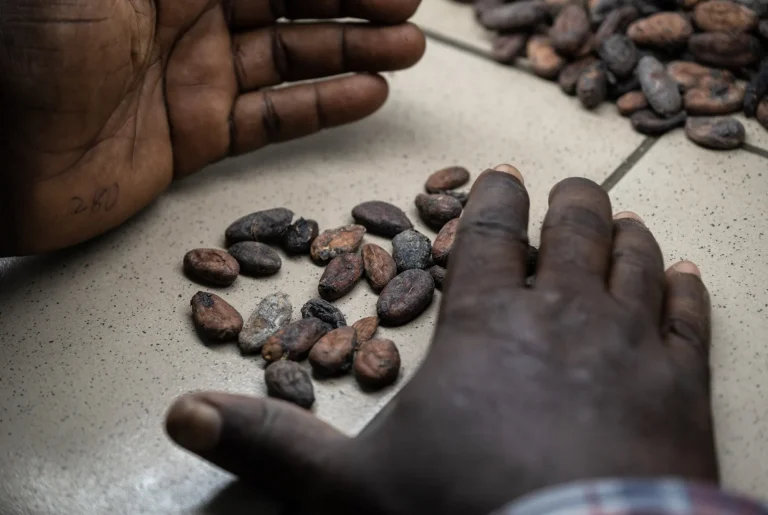
After four years, the mature cocoa tree produces fruit in the form of elongated pods; it can produce up to 70 such fruits each year. The pods, or cherelles, range in colour from bright yellow to dark purple. They ripen in less than six months and reach a maximum length of 35 cm (14 inches) and a width at the centre of 12 cm (4.7 inches). Each pod has many ridges along its length and contains 20 to 60 seeds, or cocoa beans, arranged around the pod's long axis. The oval seeds are about 2.5 cm (1 inch) long and are covered with a sticky, sweet white pulp.
Cocoa thrives at altitudes of 30 to 300 metres (100 to 1,000 feet) above sea level in areas where temperatures do not vary much below 20 °C (68 °F) or above 28 °C (82 °F). Rainfall requirements depend on the frequency and distribution of rains and the degree of water retention by the soil; the minimum rainfall needed is about 100 cm (39 inches) evenly distributed throughout the year, but 150–200 cm (59–79 inches) is optimal. Successful cultivation also requires deep, well-drained, porous soil rich in humus. Protection from strong winds is necessary because of the tree's shallow root system.

Cultivation
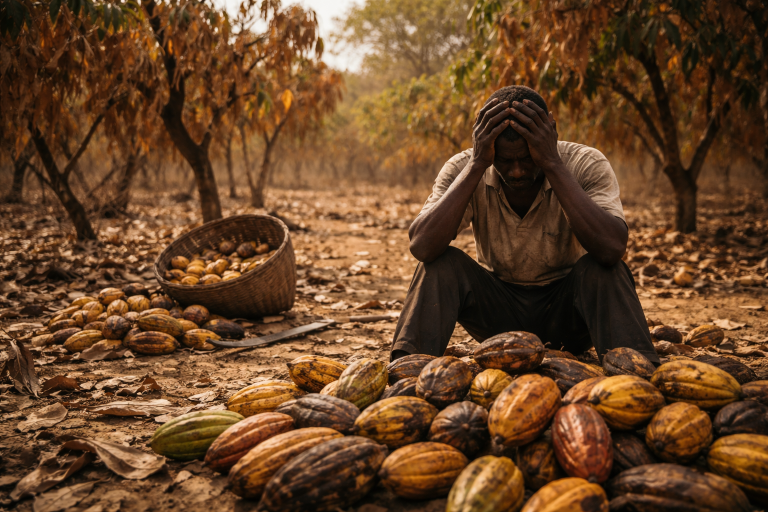
Because of the risks from disease and pests, most of the world's cocoa is grown on small, labour-intensive farms of less than two hectares instead of large plantations through which these risks can spread quickly. However, even with the protection of their small, isolated farms, cocoa growers often suffer crop losses of 30 to 100%, generally due to disease. Cocoa can also be grown in pristine tropical forests at low density as a form of agroforestry, offering an economic use of protected land. In growing cocoa, plants are first raised from seeds or cuttings and then transplanted. Other crops such as banana, palm or rubber are often planted with cocoa to provide shade and wind protection for the young trees. Flower buds are removed from the trees until they are five years old. Yields of commercial cocoa bean crops can range from less than 100 kg to more than 3,000 kg per hectare, the world average being between 340 and 450 kg per hectare (300 and 400 pounds per acre).
Many varieties of cocoa exist and can be grouped into three general divisions: forastero, criollo and trinitario. Forastero varieties are most often used in commercial production, while criollo varieties are very susceptible to disease and are not grown on a large scale. Trinitario is a hybrid of the forastero and criollo varieties and produces a flavourful bean used in high-quality dark chocolate. In Central America, two related species (T. bicolor and T. angustifolium) are grown for their edible seeds, which are sometimes mixed with those of T. cacao to produce cocoa.

Pests and Diseases
The most commonly destructive diseases of the cocoa tree are the pod rots. Pod rot, called "black pod", is caused by a fungus (Phytophthora) that spreads rapidly on pods under conditions of excessive rain and humidity, insufficient sunshine and temperatures below 21 °C (70 °F). Control requires prompt treatment with copper-containing fungicides and constant removal of infected pods. Witches' broom (caused by Moniliophthora perniciosa) and frosty pod rot (caused by M. roreri) are serious diseases affecting crops in the Americas and the West Indies and are a major concern for producers in Africa and Asia seeking to prevent their spread. Asian cocoa trees are affected by a fungus (Oncobasidium theobroma) that causes dieback, starting from the tips of the branches – a condition called vascular-streak dieback. Swollen shoot is a viral disease transmitted to the plant by mealybugs that has devastated Ghanaian and Nigerian cocoa crops.
Some common diseases such as cherelle wilt, cushion galls and dieback are not well understood and may result from a combination of physiological, viral, nutritional and fungal conditions. Many different insects damage cocoa, including mealybugs, true bugs (heteropterans), thrips and scale insects. In Southeast Asia, the cocoa pod borer, the larva of a moth, is a common pest. Research is under way to develop disease-resistant varieties and effective biological control methods against insect pests.