
The Great 19th-Century Inventions That Shaped Modern Chocolate
Before the 19th century, chocolate in Europe was mainly consumed as a drink, often thick, gritty and reserved for a wealthy elite. But during that century of industrial transformation and ingenuity…
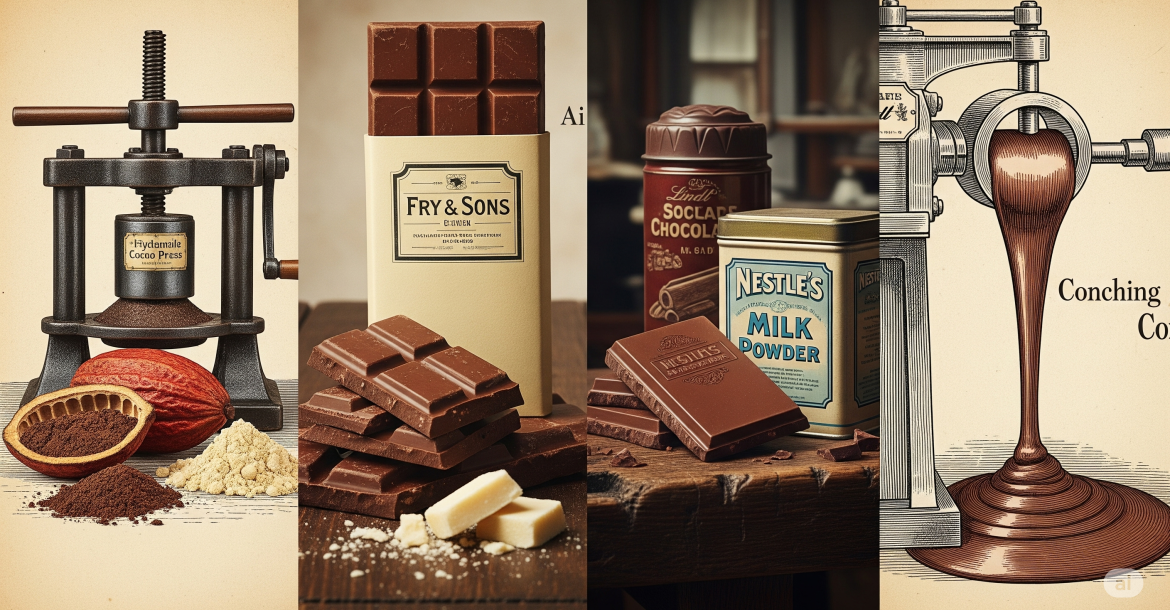
Before the 19th century, chocolate was mainly consumed in Europe as a drink, often thick, gritty and reserved for a wealthy elite. But during that century of industrial transformation and ingenuity, a series of revolutionary inventions was to transform cocoa, making it tastier, more versatile and accessible to a much wider public. These innovations laid the foundations of the modern chocolate industry.
1. The Van Houten Revolution: Taming Cocoa Fat (1828)
- The Challenge: Raw cocoa mass, obtained by simply grinding roasted beans, contained about 50 to 55% cocoa butter. This high fat content sometimes made the chocolate drink heavy, hard to digest and tricky to mix with water or milk.
- The Invention of Coenraad Johannes van Houten: In 1828, the Dutch chemist Coenraad Johannes van Houten patented a hydraulic press able to extract a significant share of the cocoa butter from the cocoa mass. This process made it possible to separate the fat (cocoa butter) from the solid part (the cocoa cake).
- Impact and Results:
- Cocoa Powder: Once pulverised, the cocoa cake gave a "defatted" cocoa powder (still containing 10 to 25% cocoa butter). This powder was much easier to dissolve in liquids, paving the way for modern chocolate drinks, lighter and more digestible. It also allowed cocoa to be used as an ingredient in baking and cooking.
- Pure Cocoa Butter: Extracting this pure, stable cocoa butter was a major advance. Not only could it be reincorporated in controlled proportions in chocolate making, but it also found valuable applications in the pharmaceutical and cosmetics industries.
- "Dutching" (Alkalisation): Often associated with Van Houten's name (sometimes attributed to his father, Casparus), this process involves treating cocoa beans or powder with an alkaline solution (such as potassium carbonate). This neutralises cocoa's natural acidity, softens its bitterness, darkens its colour and improves its solubility. This "Dutch cocoa" is still widely used today.
2. The Birth of the Eating Chocolate Bar (Fry & Sons, 1847)
- The Context: Before this invention, solid chocolate was rare, often coarse, or came as tablets meant to be grated to make drinks.
- The Innovation of Joseph Fry & Sons: In 1847, the English chocolate maker J.S. Fry & Sons, based in Bristol, had the idea of mixing cocoa powder and sugar with an additional quantity of cocoa butter (made more available thanks to Van Houten's invention). This mixture formed a paste that could be poured into moulds and, on cooling, gave a solid bar that was pleasant to bite into.
- The Impact: This was the first mass-produced "eating" chocolate bar. The innovation opened an entirely new market and marked the beginning of chocolate's popularisation as a solid confection.
3. The Revolutionary Invention of Milk Chocolate (Daniel Peter & Henri Nestlé, 1875-1879)
- The Challenge: Adding liquid milk directly to chocolate was problematic because the water in fresh milk caused the cocoa mass to "seize" (harden and turn grainy).
- Daniel Peter's Perseverance: Daniel Peter, a Swiss chocolate maker from Vevey and a friend of Henri Nestlé (the inventor of infant cereal and powdered milk), searched for years for a solution. After many failed attempts with fresh milk, he had the brilliant idea of using the powdered milk (or sweetened condensed milk) developed by Nestlé.
- The Success (1875-1879): By mixing powdered milk with the cocoa mass and sugar, Daniel Peter finally managed to create a solid, smooth, stable milk chocolate. He founded his own company to market this novelty, which later merged with Nestlé.
- The Impact: It was a taste revolution. Milk chocolate, milder, creamier and less bitter than dark chocolate, won over an immense public, especially children. It quickly became, and still is today, the most consumed type of chocolate in many parts of the world.
4. Conching: The Quest for the Perfect Texture (Rodolphe Lindt, 1879)
- The Problem: Despite advances in grinding, the solid chocolate of the time could still have a slightly sandy or gritty texture in the mouth and a certain harshness.
- Rodolphe Lindt's (Almost Accidental) Invention: In 1879, in Bern, the Swiss chocolate maker Rodolphe Lindt was seeking to improve the texture of his chocolate. Legend has it that he inadvertently left a mixing machine (which he had designed, the "conche", so named for its shell shape) running for a whole weekend. On his return, he discovered that the chocolate paste, long stirred and slightly warmed by friction, had been transformed.
- The Spectacular Results:
- Melting, Velvety Texture: Conching extended the fine grinding process, rounded the cocoa and sugar particles, and coated them evenly with cocoa butter. The result was a chocolate of a finesse and melt-in-the-mouth quality entirely unprecedented.
- Flavour Development: The prolonged stirring and aeration helped remove residual moisture and unwanted volatile acids (such as acetic acid), allowing cocoa's finest and most complex aromas to flourish fully.
- The Impact: Lindt's "fondant chocolate" set a new standard of quality and taste pleasure. The conching process became an essential step in the making of modern fine chocolate, particularly Swiss chocolate.
Other Advances of the Century:
The 19th century also saw the continuous improvement of grinding techniques (with the development of roller mills more efficient than the old stone mills), the increased mechanisation of manufacturing processes, and the beginnings of advertising and marketing for chocolate products, which began to acquire strong brand identities.
Conclusion: A Founding Century
These four major inventions – the cocoa press, the solid chocolate bar, milk chocolate and conching – radically transformed chocolate within a few decades. From a bitter, rustic drink, it became a solid, smooth confection with varied flavours and increasingly accessible. The 19th century truly laid all the technical and taste foundations on which the vast and diverse chocolate industry we know in the 21st century rests. Every bite of modern chocolate carries the legacy of these visionary pioneers.