The Arrival of Brown Gold: How Cocoa Conquered Africa
Native to the tropical forests of Central and South America, where it was grown and revered by the Maya and Aztec civilisations long before the arrival of the Europeans, the cacao tree (Theobroma cacao) set out on a long journey before…
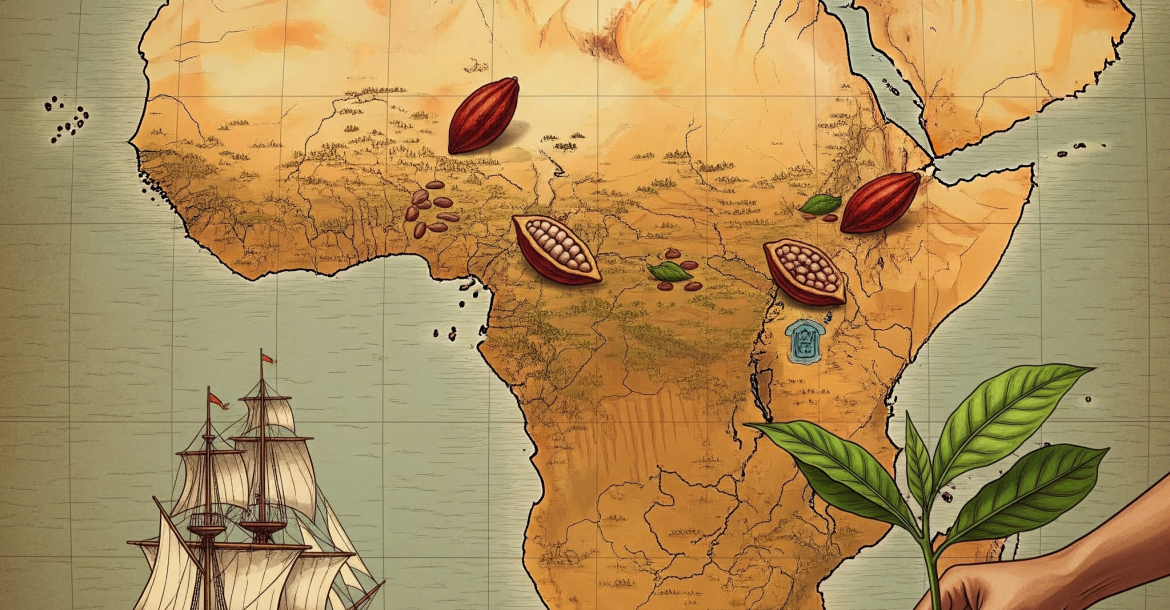
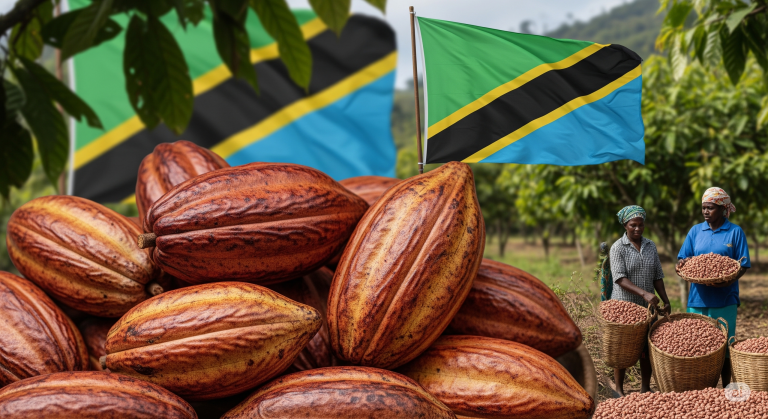
Native to the tropical forests of Central and South America, where it was grown and revered by the Maya and Aztec civilisations long before the arrival of the Europeans, the cocoa tree (Theobroma cacao) made a long journey before becoming an emblematic crop of the African continent. Its introduction to Africa, mainly during the 19th century, was largely orchestrated by the European colonial powers, radically transforming the agricultural landscapes and economies of many regions.
The First Bridgeheads: The Islands of the Gulf of Guinea
Africa truly got to know cocoa on a large scale via the islands in the Gulf of Guinea. These territories, under colonial administration, served as laboratories and springboards for the expansion of cocoa growing on the continent.
-
São Tomé and Príncipe (by the Portuguese):
- Key date: from 1822. The Portuguese introduced cocoa seedlings (probably of the Amelonado variety, a Forastero type) from Brazil to the island of São Tomé.
- Development: The climate and volcanic soil proved exceptionally favourable. During the second half of the 19th century and early 20th, São Tomé and Príncipe, with its large plantations (the "roças"), became one of the world's leading cocoa producers, earning the nickname "Chocolate Islands". This success, though tarnished by very harsh working conditions for the "serviçais", demonstrated the enormous potential of cocoa on African soil.
-
Fernando Po (present-day Bioko, in Equatorial Guinea, by the Spanish):
- Key date: mid-19th century. The Spanish also introduced cocoa to the island of Fernando Po, which became another important production centre. Beans from Fernando Po would play a crucial role in the later introduction of cocoa to the mainland, notably in Ghana.
Expansion in West Africa: The Birth of the Giants
It was in West Africa that cocoa would see its most spectacular expansion, turning entire nations into world production leaders.
-
Ghana (then the Gold Coast, by the British and local initiatives):
- Introduction: Although Swiss Basel missionaries had experimented with cocoa growing as early as the 1850s-1860s, the most famous and impactful introduction is attributed to Tetteh Quarshie. This Ghanaian blacksmith is said to have brought cocoa pods back from Fernando Po in 1876 (or 1879 depending on the source) and to have established the first cocoa farm at Mampong-Akwapim.
- Development: The crop spread rapidly among local farmers, encouraged by attractive prices and the (sometimes belated) support of the British colonial administration. By the early 20th century (around 1910-1911), the Gold Coast became the world's leading cocoa producer, a title it would hold for several decades.
-
Nigeria (by the British and local initiatives):
- Key date: introduced as early as 1874 (according to some sources, also via Fernando Po, or by local chiefs). The first plantations developed in the Calabar and Bonny region.
- Development: The crop then spread to the west of the country, in the Yoruba regions, which became the main production basin. Nigeria quickly became a major producer, often ranking among the top three in the world in the mid-20th century.
-
Côte d'Ivoire (by the French):
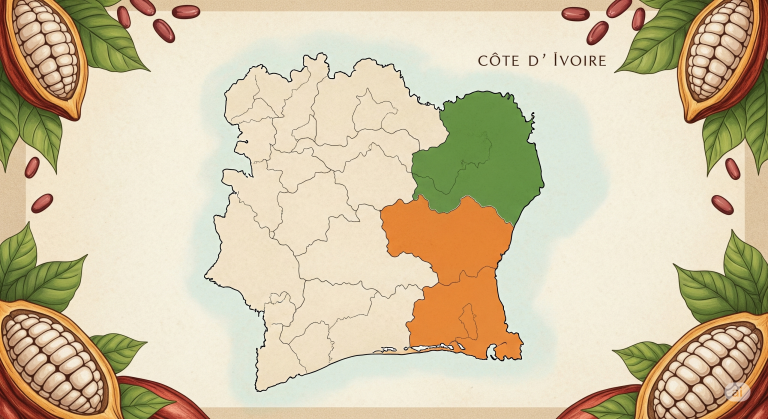
- Key date: late 19th and early 20th century. Cocoa was introduced to Côte d'Ivoire by French settlers (and potentially through cross-border exchanges with the Gold Coast). Figures such as Arthur Verdier played a role in the first attempts. The first plantations organised by the colonial administration and adopted by local populations were in the east of the country (Indénié, Sanwi) from the 1900-1910s.
- Development: Expansion was modest at first, but after the First World War, and especially from the 1920s and 1930s, production accelerated. It was after independence, in the 1960s and 1970s, that Côte d'Ivoire, thanks to a proactive policy and the migration of planters to the western "pioneer fronts", saw a spectacular boom, finally overtaking Ghana to become the world's leading producer at the end of the 1970s.
-
Cameroon (by the Germans, then Franco-British):
- Key date: introduced in 1886 or 1892 by German settlers, who established large plantations notably on the slopes of Mount Cameroon.
- Development: After the First World War, the territory was divided between France and the United Kingdom, which continued to develop cocoa growing. Cameroon became an important producer, with significant production in the Centre, South and South-West regions.
Factors in African Expansion:
- Ideal Agro-Ecological Conditions: The equatorial forest belt of West and Central Africa offered a hot, humid climate, rich soils and natural shade areas suited to the cocoa tree.
- Colonial Policies: The colonial powers actively promoted cocoa as an export cash crop, to feed their nascent chocolate industries and generate revenue.
- Adoption by Smallholders: Unlike the large-plantation model of São Tomé, expansion in West Africa was largely the work of millions of small family farmers. Once the economic benefits were perceived, they quickly adopted and extended this crop, often by clearing new forest plots.
- Growing World Demand: Rising chocolate consumption in Europe and North America stimulated demand for beans and encouraged the expansion of production.
Conclusion: A Continent at the Heart of the World Cocoa Economy
The introduction of cocoa to Africa, although motivated by colonial interests, profoundly transformed the continent. It created new sources of income for millions of people and positioned countries such as Côte d'Ivoire, Ghana, Nigeria and Cameroon as unavoidable players on the world economic stage. Today, Africa supplies more than 75% of world cocoa production, a direct legacy of this complex history that began just over a century ago on the coasts and in the forests of the continent. Understanding these origins is essential to grasp the sector's current issues, from sustainability to fair pay for producers who are the descendants of those first African pioneers of brown gold.